

How to Write an Effective Sales Email or LinkedIn Message
When reaching out to prospects, your wording and style is important. Unfortunately, I see poorly written sales communication every day. Here are some tips for writing an effective email or LinkedIn message that gets a response.
When reaching out to prospects, your wording and style is important. Unfortunately, I see poorly written sales communication every day. Here are some tips for writing an effective email or LinkedIn message that gets a response.
Write your email like you are sending it to one person, even if you are sending it to many people. I like to pick someone I know and write it to them in a friendly, professional manner. I avoid using marketing language. Use small paragraphs because it is easier for the reader to quickly digest the information. Keep your entire correspondence short and to the point.
Use a friendly opener that personalizes your email. If you have time, note something about their experience or something you know about them.
Next, state the reason for your connection or the action you want from them. If you would like to set a meeting, say that up front. People are busy and if they can’t determine quickly why you have reached out, it will get deleted or ignored.
In the next paragraph, write a couple sentences answering the question – “What is in it for them?”. This is telling them the benefit of having a relationship with you. Use strong, positive language about how others have benefitted from what you have to offer and your experience.
Don’t sell them in this email if your product or service is normally sold after a relationship is formed. Write this like you are starting a relationship in order to find out if you would be a good match to work together. Keeping this in mind helps you to not sound desperate. It showcases the value to those who are willing to improve their situation by discovering your product or service – and you!
Make it easy for them to respond and move to the next action. If you would like to set a meeting, send them possible meeting times so they can respond to the next step and move the relationship forward.
Remember that if you send an email out through an email service, it can get stuck in junk folders and filters. If it is important to you, cut and paste personal emails to one address at a time and adapt it slightly for the person you are sending it to.
Starting a relationship off right when selling your product or service is worth the time investment to a good prospect. A final reminder: don’t give up. Just because you didn’t get a response the first time, doesn’t mean they aren’t interested. Reach out again with slight tweaks to test what may resonate with them. And above all, have fun!
Wondering what you can do now regarding race relations? Here’s a start.
I spent years developing and implementing programs that brought people together of different backgrounds to discuss race, diversity and inclusion.
As a white American, I had a desire to understand why things hadn’t changed and hoped that this information would provide me a roadmap for what I could personally do about it.
Based on hundreds of discussions about the topic in the community, here’s what I learned, and what you can personally do now.
What you are exposed to is what you believe to be true. Your upbringing and your experiences create your belief system. The best way to expand what you believe, is to identify with new information personally. It is the personal connection and understanding that widens our view when it comes to understanding others.
Start at the beginning. Offer to have a conversation with someone of a different race and start with these questions.
If you are open to it, could we have a conversation about race? If yes, continue.
Can you tell me about your upbringing and how race was talked about in your home when you were younger? Do you discuss it in your home today? Each of you share.
Talking in “I”, not “we”. These conversations go better when remembering to share your own experience by starting each sentence with “I”. When “we” is used, it moves the statement from personal to a group which can be dividing.
Remember the spirit of the conversation. The purpose is to gain understanding. I have found these conversations don’t take place because it can be uncomfortable, or people are afraid they might say the wrong thing. If something is said that you view negatively, get clarification with these questions:
Can you tell me more about that so I can understand it better?
When I hear you say that, I think ________. What are your thoughts after me sharing this with you?
Assume what is being said is true. There are so many mixed messages in the media. When having these personal conversations, we found it helpful to encourage participants to believe what each other was saying. One person can see something one way because of their experience and another can see it differently based on theirs. Because of this, it is all “true” and it doesn’t have to make one-person right and one person wrong.
Remembering we are all human. As humans, we don’t connect with all people the same. I have friends that when we first met, we didn’t have the same view on some subjects. As I got to know them, I found other areas for connection. Keep that in mind here.
Share with each other what you learned. Sharing any new information you learned eliminates the opportunity for assumptions about what each person is taking from the conversation and provides more insight.
The differences between race has been talked about for a long time, however I don’t believe we do enough discussion in this way. Not only does it help with understanding others in a new, more personal way, but it starts the opportunity for a deeper relationship and friendship. It changes how we view others, and what we say about them.
If you want to be part of the solution, you can be. It is a large problem and my experience in leading conversations about this difficult topic has changed how others view race, their actions toward it, and how we can go about making a difference – one person at a time.
Empowering Yourself and Your Team in Transition
Transitions can be tough and sometimes we don’t even recognize where we are in the process or why we are feeling the way we do. Ironically, this is exactly what is needed to move forward to the next successful stage

We are in some major transitions right now. How much have you recognized this for you and team? Doing so helps to move through the phase faster and go in the new direction, but can seem counter intuitive. Even though it seems we have adjusted to this new way of operating, many of us are still in this transition phase and will be again as we move back into an office work schedule.
By nature, we are impatient. As things around us change, we want to change with it – and quickly. However, our minds and bodies need time to adjust. A transition time is the time between events. Whether we are aware of it, or not, our brains have been working toward a future vision. Once that future changes, it takes time and energy for our brain to readjust and we go through a grieving period. This can show itself in the body and we become more fatigued (as evidenced by COVID nap times) and it is harder to make decisions.
Here are some tips for helping you and your team honor the transition time and also move forward.
Recognize where you are in transition. In coaching there is a saying – when you name it, you claim it. Have a discussion with each of your team members. Journal for yourself. Everyone is at a different point. A client this week had no transition time. She went from leaving a job to starting her own business, while home schooling kids and having no electricity for days because of the storm. What she needed most was sleep and hadn’t allowed for this.
On a scale of 1 to 10, how well do you think you are doing in this time of transition, and why?
List what you still have. It is easy right now to think about what has been lost. With another client this week, she recognized her ability to have deep relations with her clients has always been there and is even more important now, regardless of negativity she felt from the company. If you are a manager, this moves your team to a positive state of mind.
What are your traits and abilities that have created success for you in the past?
How has their importance changed today?
Imagine your future self. Helping the brain to visualize a new future “rewrites” the neurological pathways to move into a new, more solid direction.
Imagine yourself past the stage of the unknown or fear. It is a day in which you are successful in the future. What do you see?
What do you need to rely on in yourself now to move toward this future?
What do you need to let go of so you can do that?
Make an agreement. Making an agreement with yourself or your team member solidifies next steps and a time frame. It is important to have a commitment that is both energizing, a little challenging and realistic. As a manager, we tend to want more control and can end up squashing the autonomy that lets individuals really shine.
What can we agree on that you will do this week that is a little challenging, energizing and realistic?
How can I support you?
Transitions can be tough and sometimes we don’t even recognize where we are in the process or why we are feeling the way we do. Ironically, this is exactly what is needed to move forward to the next successful stage.
Here is What is Really Keeping You From Reaching a Goal
There is tremendous waste in this world, but none greater than a desire of the soul left unfulfilled. Not only do you have the opportunity to pursue that dream, but to grow beyond what you can imagine. What will you do differently today?

What goal or dream do you have that you have not accomplished?
While some goals could be things like making more money, traveling, growing your business, there are others like working less hours, working smarter and spending more time with family. Are there any goals or dreams that you have that are so meaningful to you and just seem out of reach? A stretch? Impossible? I talk with people every day who have a desire to achieve something and yet are held back from doing so. They feel stuck.
Here are some questions to start the process of understanding what is specifically inside you that might be unconsciously keeping you from achieving those goals.
Ask the magic word - Why. Picture the scene of the annoying younger sibling continuously poking and asking the question “why”. But “why” has magic in it because it helps you to completely understand why a desire is important to you. You do this by asking “why” over and over again. Want more money? Why? Answer. And why is that important to you? Answer. What about that is meaningful? Answer. Why? You get the picture. Allow yourself to be transparent and dig deeply into the reasons.
Investigate your anchors. Anchors are old habits or beliefs from our past that “anchor” us to the spot we are now and keep us from moving into a new place. They show up as stories we tell ourselves or behaviors that served us to get us where we are now but aren’t needed anymore. They can be conscious or unconscious and are something we learned and absorbed earlier in our life. Recently I was coaching someone taking her business so seriously and wasn’t having fun. After exploring that, she learned that since she had gone through a difficult time years ago and had to be serious to get through it, that she was still in that mode even though circumstances were vastly different now.
Name your blocks. Blocks keep us from understanding where we want to go and how to get there. They are parts of ourselves or our path that we may not see. These generally are repeating patterns that block us from making new movement in a different direction. Oftentimes it takes a coach or other professional to point out blocks that might be occurring and reroute this behavior or thinking to a new one that shifts us into big change. For instance, in a conversation in which a business owner was struggling for employees to take ownership of their work, she discovered that because of her background she was acting as a mother figure to them keeping them in child-like role.
Imagine the breathtaking scenery. Imagining breathtaking scenery is when we allow ourselves to be in the future when the goal or dream is realized and describe it in as much detail as you can. What will it look like when you are living your dream? How can that scenery be expanded even more? What will it feel like when you have discovered more about your potential then you ever thought possible? Remind yourself of this scene regularly.
There is tremendous waste in this world, but none greater than a desire of the soul left unfulfilled. Not only do you have the opportunity to pursue that dream, but to grow beyond what you can imagine. What will you do differently today?
What the “New Normal” Will Look Like
What will the future look like? People are talking about the safer-at-home restrictions lessening and the economy “getting back to normal” while still holding the uncertainty of what the new normal will look like.

This is a time of transformation. Not only have we been forced to physically stay in place, but also to have our regular activities, and our lives change.
For some of us this means more time with ourselves. For some of us it is less time with ourselves, as we have kids back home or new problems to solve. For some of us there are questions rattling around in our minds, as we want to determine and decipher what our future will look like.
What will the future look like? People are talking about the safer-at-home restrictions lessening and the economy “getting back to normal” while still holding the uncertainty of what the new normal will look like.
Because of all that has happened, there is negativity around us and people are hurting in different ways. This hurt brings grief and with that, a grieving process. Some are grieving the loss of someone they loved, some are grieving the loss of a job, some are grieving choices that needed to be made that affect others and some are grieving the loss of their life as they knew it. Taking time to recognize this grief is important because when all that fades away, new possibilities emerge.
Change can bring about other awakenings in ourselves, if we are open to that possibility.
What will we keep with us that are important lessons from this time? I am not talking about the “academic” questions, like how your office job will be different, or how to stop the spread of germs, or new tasks that need to be accomplished. I am referring to the more important lessons of what we have learned about ourselves. What we have learned that is inside of us?
I can’t help but wonder if this was an opportunity to shake us out of our regular patterns in which we had fallen. Patterns make us feel secure. Patterns make it easy to continue each day in the same way and can hinder us from looking at who we are internally and asking questions that bring us to what really matters most.
In what ways did this change reveal something to you about yourself that needed waking up? What positives will you take from this experience that you want to remember moving forward? What changes do you know you have yet to make about who you are and what you are bringing to this world? In what ways would you like to share your gifts differently?
I have already heard from some of you about ways you are shifting. If there are others of you feeling a transformation, I would be honored to be part of this process. I am offering three hours of coaching at no charge to a limited number of people, and I still have a few spots left. There is no catch. Just reach out to me at Kate@k8co.com.
We all are unsure of what the new normal is going to look like. The one thing you have control over is exploring what this means specifically for you.
Secrets to Starting a Meditation Practice
If there is ever a time to start meditating, now is it. It is an excellent form of stress relief and a way to “clear the clutter” in your mind, which helps in everyday life.

Meditation is an important part of my life. I was on the phone with a work friend and she was surprised to hear how often I meditate.
Most likely, you have already heard the benefits of mediation, so I won’t go into them here. I will say, however, if there is ever a time to start meditating, now is it. It is an excellent form of stress relief and a way to “clear the clutter” in your mind, which helps in everyday life.
Here are a few basics to get you started:
Intention is important. Meditation is a ritual. Find a time that works best for you to start, in which you can start by doing it a few minutes every day. I meditate in the morning as the sun is coming up, in a room, by myself, with no intrusions. It is important to have no distractions. Lock the door if need be. One of the reasons I mostly meditate in the morning is everyone else is still asleep.
Meditation starts in the body with awareness and breath. When I first started meditating I used the help of a relaxation app. There are many out there but one that particularly helped me is by Andrew Johnson, because he leads you through relaxing parts of the body. Find one that works for you.
If you can sit in silence, do. Concentrate on your breath going in and out. Most people find this difficult because of the chatter in your head. This will change with a regular practice.
Head chatter is normal. There are two things to remember with this chatter. The first, is to reward yourself each time you notice the chatter and come back to your breath. The second is I have found this chatter to be a natural part of when I start to meditate. I call it filtering. My brain is actually filtering out all my activity and thoughts (my to-dos, what happened in my day, etc.) before it can get to the meditation place. Filtering is a “cleaning out” and is a good thing. If you’ve never meditated, you essentially have years of cleaning out to do. Let this filtering happen and look at it positively. Then reward yourself for coming back to your breath.
Sit in a comfortable position. Most pictures of meditation include a person sitting cross legged on the ground. I have a very hard time doing this, as I am not flexible. I either sit in a comfortable chair or lie down (not recommended if you think you’ll fall asleep).
A mantra is important. It is not what you say that is important, it is what the sound feels like and the vibration it causes. The traditional “ohmmm” is good for this. I started with saying the words “I am” repeatedly. Find something that is soothing to you.
Consistency is better than length. Start small. A few minutes each day will do and you can gradually build up. Meditation helps me to calm myself, make better decisions and focus on what is most important.
Making Decisions in Times of Stress
In times of stress, decisions can become more difficult. There have been times where the environment is not in my control and I am challenged with making a decision. There are several thought processes I try to use during these times of indecision.

I was at the grocery store picking up a few items and came across the rice aisle. Like a mirage in the desert, there were several large bags on the shelves.
Let me back up. I like grocery shopping, but going to the store now is stressful from the moment I step into the somber parking lot and am handed my sanitized cart. Over the past several weeks I would say I have been “virus sensible” when stocking my pantry and with success. There has been one shortcoming, however; I have only found one small box of Rice-a-Roni.
As I stared down at the five-pound beauty, I oddly became indecisive. Do I really need a multi-pound bag of rice? At this point I had plenty of other food. However, I do have more kids home to keep fed, however, someone may need it more than I. However…Stop.
Do I often have moments about something seemingly small? No, certainly not. But given the circumstance at the moment, here I was.
It got me to thinking about how in times of stress decisions can become more difficult. Pre-pandemic there have been other “bags of rice” moments – times where the environment is not in my control, my mind races looking for an answer, and I am challenged with making a decision, sometimes large, sometimes small.
There are several thought processes I try to use during times of indecision:
Breathe. Deep and slow. It sounds simplistic, but recognizing my breath brings me out of my head and evokes calmness, a better environment for sound decisions.
Recognize there are no right or wrong answers, only the one I make. This is a little more philosophical. The idea is that when you make a decision based on what you know at this moment, it is just a step leading to something else to grow from. I have plenty of times I look back and wish I had done something different. Was it the best decision I could have made at that time, given what I knew? Now what have I learned from that?
Phone a friend. Gather information. Say it out loud. This is not practical for a bag-of-rice decision but definitely for larger ones. Research and get advice when possible, but there is particular magic in just saying something out loud that helps to clarify things in your own mind.
In the end, trust your gut, your higher power or both. Go back to your breath and when you are calm, think about what you already have – the ability to make this decision. Think about how you already have your answer because of these resources to help you.
Did I really go through all these steps as I stood in the aisle? No. But a couple. Did I buy the bag of rice? Let’s just say that isn’t as important as leading me to share these decision techniques to help you find the right answer for you.
Finding Meaning by Setting Morning Intentions
What are your intentions for the day? When your day ends, what will you be most fulfilled with? Having and fulfilling your intentions helps to establish deep purpose…something we call can use more of during this uncertainty.

Now that my daily routine has changed, I find it even more important to set my morning intentions.
My intentions are not my to-do list. My intentions are everything “behind” my to-do list. They are guidelines that I want to live by for the day. What are the things that will make my day most meaningful?
For example, here are my intentions for today:
I will get more out of my “headspace” today and take centering breaks or moments away from the news and my work to bring myself into my body by taking deep breaths. I will then read this list as a reminder of what is most important.
I will approach each task and interaction with curiosity. I will be open to learning in each situation no matter what arises.
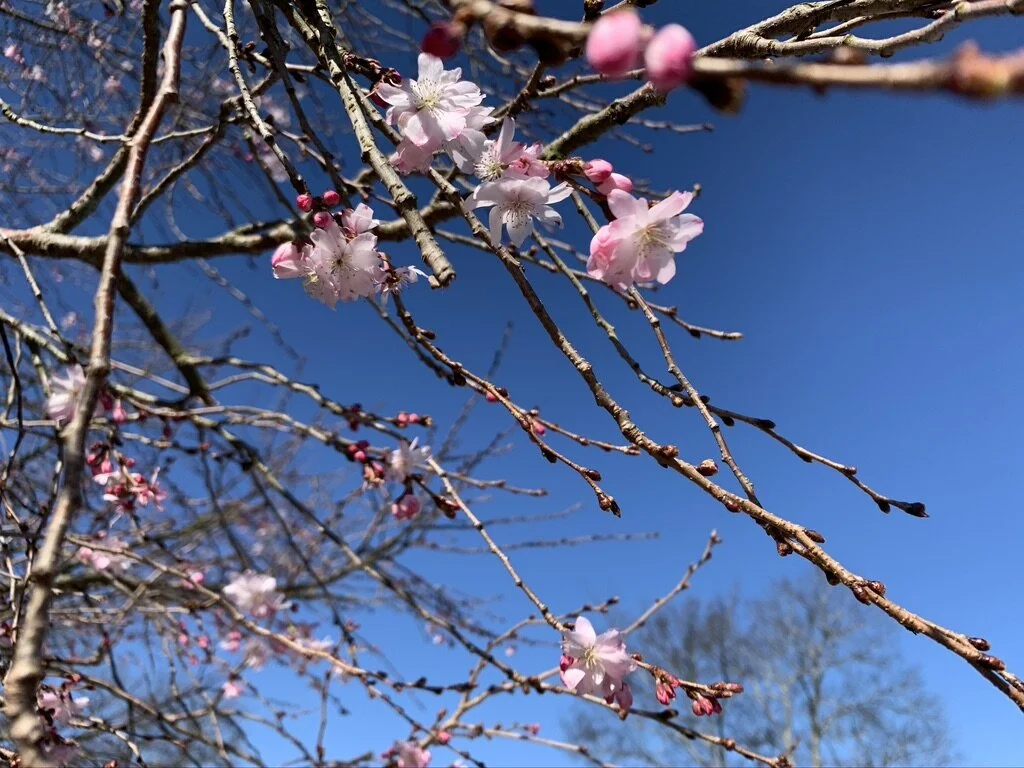
I will find the small moments in the day to recognize something beautiful. The photo here is what I took on my run yesterday morning as I stopped and focused on the colors in nature – the robin, the blooming tree and the blue sky.
I will express kindness, wonder and love and recognize when my thoughts are fear based which cancels out these positive feelings.
I will make decisions today even though my future is undecided and uncertain. I will ask myself: Do I know this is the right time to make this decision and take action? If this answer is “yes” I will move forward no matter how difficult. I will remind myself that every decision, even though it may be hard, can have positive consequences in the long run that are unforeseen.
I will note things I am grateful for that normally I may be too rushed to notice. A moment laughing in the kitchen with my daughter, a meal I cooked.
What are your intentions for the day? When your day ends, what will you be most fulfilled with? Having and fulfilling your intentions helps to establish deep purpose…something we call can use more of during this uncertainty.
Every Crisis is an Opportunity: What to do Now to Ensure Your Business Comes Out of COVID-19 Strong
Start looking ahead to ensure your business will come out of this situation better positioned for future growth. Being proactive with your strategy will not only create a sense of control for your future but start moving in the direction of recovery and success.
In the past few days, I have gotten comments from colleagues mentioning that now is a good time for them to catch up on projects they are behind on. My advice to leaders is to not look behind or simply get caught up, but start looking ahead to ensure their businesses come out of this situation better positioned for future growth.
With every crisis, there is opportunity. At the end of this, some businesses will close, while some will flourish.
Imagine a future time. Pretend the crisis has past, the virus is over, and social distancing is a thing of the past. People are back in the workplace. While the world is different, given this situation, and there are many unknowns, company strategy is built on brainstorming to predict the future.
How has your client and prospect’s business changed? What will they be experiencing with their clients? Do your homework, read about the effects in their industry. Conduct phone interviews with clients and prospects, if appropriate, to understand what they are going through and what changes they have had to make.
What will your clients and prospects need then? Now that you know what your clients are experiencing and understand their changing business needs, how are you prepared to help succeed - and quickly. Are there new products and services that you can offer to help them in their recovery and growth? How can you make your current products and services more efficient and cost effective in the short term to aid in their recovery?
Conduct a SWOT analysis. This is a strategic management tool that is very effective. However, in this situation, imagine you are in the future and listing what you see for each bucket - Strengths, Weaknesses, Opportunity and Threats. If it is in the future, people are back at work and you know what your client’s needs are, how does your client’s business look in this future environment?
Develop your action plan to meet this future business world. What business changes do you need to make now? What will your employees need? Are there new lines of business you have wanted to create that now make sense to develop?
And finally…Abundance vs. fear. We are currently in an unknown time which is stressful. Not knowing the future is scary and creates fear. Keep this in mind as you go through this exercise and remove this fear. Remind yourself that things are cyclical and instead think in abundance and how you can create a business plan that makes your business even stronger than it has been in the past.
It is natural during this time to hunker down and sit and wait and see what will happen. Being proactive with your strategy will not only create a sense of control for your future but start moving in the direction of recovery and success.
Remembering Names While Networking
Networking is essential to building your business. It provides the first step to a possible relationship and can build credibility for your company and expertise. Here are some tips to help you in this situation.
I recently was at a business event in which a small group of us were talking about the difficulty of remembering people’s names while networking.
One woman explained that she never forgets a face, but that she is not good with names and then wonders how to respond when seeing someone again. Here are some tips to help you in this situation.
Nice to see you. I am a big networker – I go to many events and have met many people. For this reason, I have learned not to say “Nice to meet you.” due to the numerous times that was followed by the person politely telling me we have met before.
For this reason, I always say “Nice to see you” as a general response which leaves the door open for whether this is a first-time introduction or not.
Introduce yourself first. In the instances in which I know I have met someone but I don’t remember their name, I make the assumption this is true for them, as well.
As a way to get past what could be an awkward moment, I immediately offer to shake their hand and introduce myself first giving them my name.
This is followed by them accepting the handshake, giving me their name and sometimes explaining we have met before and that they know who I am. I follow up with that I didn’t want to assume that they would remember me.
Have a clear name tag. Instead of leaving the name tag in the hands of the event planner, I have my own plastic name tag made with my name clearly printing in big letters, my company name and my logo, making it easier for others to see and remember who I am.
When business cards are exchanged (and yes! business cards are still important) study their name and company. When I get to the car, I often make a note on it to help me remember our discussion and them.
Networking is essential to building your business. It provides the first step to a possible relationship and can build credibility for your company and expertise.
The more you are comfortable with it, the more you can Cultivate What Counts. Watch for my book on this topic to be relaunched soon!
Do You Say “Yes” When You Want To Say “No”?
Saying “no” to things you don’t want to do, is important and healthy. If you find yourself saying “yes” to things you don’t want to do, ask yourself why.
I recently met with a client who planned four back-to-trips, some work and some fun. She was fearing the upcoming months – even though they were filled with many activities she was previously looking forward to – and wanted to discuss how to survive the months ahead. The real discussion became why she was saying yes to items that she didn’t want to do.
This is a scenario I hear of often and can relate to. Here are some reminders that help me accept that saying no is not only okay, but healthy.
Is this something I really want to do? This is my first check. If the answer is an enthusiastic “yes”!, I am in. If I start thinking it is something I “should” do – that is a warning flag. More often than not, I say no to those things I think I “should” do because…
…When you say yes to something, you are saying no to something else. Time is one thing we have that, when it is gone, it is lost forever. If you have set goals for yourself or determined priorities important to you, focusing on those things means not letting other activities eat into that time. It changes your focus from pro-active (you actively do things you want to do) to reactive (letting things that come up dictate your schedule).
Speaking for myself. My husband has a wonderful saying – “I’ll speak for myself and I will let you speak for yourself.” What he means is don’t guess what another person is thinking, don’t guess what another person wants you to say, and don’t guess what another person thinks about a decision you made. The more we try to guess what others are thinking, the more we are undermining ourselves and what is important to us.
No judgement. Recently I agreed to a regular social group activity after work. I then got a large client that I needed preparation time for. As I let the group know (and felt badly about it) another group member said, “There is no judgement here. We all have things that come up. You are welcome whenever it fits back into your schedule.” How refreshing that was! We judge ourselves when it is not necessary. And, in reality, we want to have continued relationships with those who are graceful and understanding to situations like these.
Adults tell. Children explain. I once had a friend tell me that when giving a “no,” it is not necessary to explain why, because “adults tell” and “children explain”. A simple “I have a commitment that day.” will do. And you do have a commitment – to yourself!
Saying “no” to things you don’t want to do, is important and healthy. If you find yourself saying “yes” to things you don’t want to do, ask yourself why.
There is power in a “no” and that is being true to yourself and who you want to be.
My goals is to help you cultivate what counts in work and life. Sign up to receive more blogs here https://www.k8co.com/contact.

Centering Exercise: Calming Focus
Centering is a valuable exercise to physically calm your body and to help you focus on what is important.
It is a form of meditation that can be whatever length you want and can be surprisingly useful in only a few minutes.
Centering is a valuable exercise to physically calm your body and to help you focus on what is important.
It is a form of meditation that can be whatever length you want and can be surprisingly useful in only a few minutes. I meditate daily and use short centering exercises throughout the day to get back in touch with my inner self, calm my body down and provide focus.
Feel free to relax as you read it out loud, or tape yourself reading this, or just use the general sense of it to develop your own centering exercise that works for you.
To begin, take a deep, slow breath in and then out. Close your eyes if that is comfortable for you (if you have this taped).
Feel your breath – take another deep breath in…then out.
Take one more breath in…and out.
Notice your breath. As you breathe in, imagine taking in all positivity and goodness and as you breath out, breathe out any negativity and harm.
Notice your physical body. Notice how your body feels – your feet…your center…and your head. Release any tightness you feel – let it go as you breathe out.
As you continue slowly breathing in and out, recognize that you were brought to this very moment in time. You have a purpose in this world that is filled with love and knowing. And at this particular moment, you deserve to take a few minutes to feel this love and knowing. Picture it as a warm light in the center of your body.
Part of this knowing is that our existence is enough. Just our existence is enough, and all other demands and expectations can fall away.
As you think about this base feeling of existing, you will recognize that our existence has a natural purpose. Because of our natural purpose, we will be guided by what needs to be done and there will be no need for force. We will do those things that are in our center, our core being, as opposed to those things we think we should do that tend to be in our head. When we are in touch with this knowing, it helps us to live our day with this natural purpose that will unfold in calming moments.
Take another deep breath…in... and out. Continuing slowly breathing and centering on this thought until you are ready to open your eyes or conclude. Take a moment to notice how different you feel.
The more often you use centering, the more you will see results. Practicing it regularly can improve your outlook, heath and productivity….a big payoff for the minutes spent and a powerful way to cultivate what counts.
Resolutions are out. Focus is in.
We are a week into the New Year – Welcome 2020! I am not big on New Year’s resolutions. Why? Because stating what you will do only once a year is not sustainable or fulfilling. When it comes to personal goals, I like to do just that – create goals - but on a monthly basis.
We are a week into the New Year – Welcome 2020! I am not big on New Year’s resolutions. Why? Because stating what you will do only once a year is not sustainable or fulfilling. When it comes to personal goals, I like to do just that – create goals - but on a monthly basis. The reason for this is things change and while you can set long range goals for yourself for the year, creating a monthly focus helps to keep you on track and to adjust to what is most important at the time. Here are some steps for creating your focus goals:
Put yourself at the end of 2020. What would have to happen in order for you to be most fulfilled? Think of the end game in your work, family, health, wealth and spiritual buckets. It is best to talk in generalities here (dare I say to forget about SMART goals?) – Do you want to be more healthy? Then say that and why.
The important thing is to paint the picture in your mind of what you want your future to look like.
Do a short centering exercise to set your monthly focus (for centering instructions, see accompanying blogs).
Determine monthly theme. As you think about your month, what words come to mind with there you are at now and what you want to remind yourself throughout the month? Some of mine in the past have been Preparedness, Gain Clarity, and Get to it. Don’t overthink this – whatever set of words come to you is what you can use.
Determine steps to take this month in each bucket. This is where the magic happens. Only choose 2-3 steps in order to make it manageable. If you do this in each bucket you will end up with about 10-12 simple things to do this month to move you forward.
Write accomplishments in a monthly calendar. This is one of the most important steps that is often overlooked. On a separate monthly calendar, I write my highlights and accomplishments. Write down the one thing that happened that day that was meaningful for you. Did you start a new workout? Land a big appointment for work? Write it down. I tend to be very hard on myself and think I haven’t done enough toward my goals, when I actually have. Looking back and celebrating my accomplishments motivates me for the next week.
Repeat and be flexible. Each month I read through my year’s goals and reset my focus for the month. Adjust anything that has changed and realize it will. We are humans and not robots so nothing is consistent – it ebbs and flows. For instance, when I had a relative become sick more of my focus changed to time with family.
Enjoy and have fun. Life is an adventure and can be both messy and rewarding.
I’m here to help you cultivate what counts in your work and life and so you can be more fulfilled.
Creating Space
"Crazy busy" is a term all of us use at one point or another but are you productive with no satisfaction? Learn the first steps to creating space for more fulfillment.
In the last couple weeks when talking casually with people, some phrases that I have heard are “I’m crazy busy” and “I really haven’t had time to think” and “between work and kids I am just trying to survive.”
I get it.
Actions happening around us can take over and drive us through out our day. We move from accomplishing thing to thing and at times are satisfied with our productiveness but at the same time wonder where our day went and why we feel exhausted and flat. When was the last time you felt satisfied in your work? Not just “productive satisfied” but the feeling that you are accomplishing your life’s dream and it leaves you so energized inside you feel as if you can do anything? Where did that feeling go, and how do we claim that back?
The first step is to create space in yourself to start cultivating an environment that enlightens what is most important to you.
You may answer, “Well, Kate, I already know what is most important to me. It is my kids.” Yet we can carve out more time to spend with our kids and not be fulfilled. Notice I didn’t say creating space in your day…but creating space in yourself.
The energy we expend is exponential. Energy that feels overwhelmingly satisfying to us, the kind that “lights us up” and makes us feel as if we will burst inside with enthusiasm is something that takes up space inside us and can grow. Likewise, energy spent on tasks that leave us drained and feeling “blocked” can take up space and grow. We can get so “crazy busy” that it leaves no room inside us to locate the dreams that fulfill us most.
There is a first step. Take time to be with yourself to listen to what your desires really are. It doesn’t have to be a long amount of time. It doesn’t have to be in the Bahamas (although you won’t hear me argue against that!). It just needs to be time where it is quiet and it works for you to take some deep long breaths, get out of the chatter in your head, and to listen to what is in your core.
For some this is meditation, for some this is staring at the sky, for some this is time in nature, for some it is writing in a journal. Find a ritual that works for you because practice is important. Ritual is important. Your body will eventually become used to the ritual and want to oblige. Where at first you only hear chatter of your day (I call this filtering) eventually your brain will rest and you will hear what is deeper…what you are to do with this space while you are here on earth. Once you discover that, you will cultivate what really counts and find satisfaction in your to-do list at work, with your kids and in your life.
Why I Quit My Executive Job After 25 Years (Without a Clear Next Plan)
Have you ever been really good at something, but it just doesn’t fulfill you anymore? Find out why Kate went on a mission to discover "what is wrong with her” and what she uncovered.
I quit.
It was a really hard thing to do. The thought started about seven years ago and instead of pulling the trigger, I stayed with it and tried to make it work. There were so many things I loved about it – the mission, the people, the community. We were successful as a team, making profits and doing innovative work. And yet, deep down I knew I was supposed to be doing something else. But why?
Why would I want to leave when I had the perfect job? Something must be wrong with me, I told myself. So I read books on motivation, doubled down on my planning and goals and created new programs to fulfill me outside the normal scope of work. The success continued. People told me I was excellent at my job. I was used as an example of a strong woman. But still no. Something didn’t feel right. Instead I had a series of illnesses, caused in part due to other factors in my life that weren’t going well. A failing marriage, a sick child. This all became another reason to not leave my job. It was the only real stability I had, wasn’t it?
So I stayed. I developed a new mission. The mission: Find Out What is Wrong with Me.
This was a five-year journey. Individual therapy. Group therapy. Voracious reading on topics such as Finding your Calling, Understanding your Inner Thoughts, How to be Self Aware, How your past Unconsciously Affects your Future. I started meditating to relieve stress. I ran 20 miles a week. Things slowly got better and made more sense. Why? Because I discovered there is nothing wrong with me.
Instead, what I needed to change was how I perceived the world and my place in it. As I went through this discovery I was worried I would change. As my now husband refers to it – “It is still the same you in there, you are just clearing the clutter.”
As I cleared my clutter, I created more fulfillment in what I was doing. I became more satisfied and had clarity on what feels right for my existence. I started to feel the expansiveness of what I could offer instead of feeling small. I started to have ideas that didn’t fit in the confines of my job and want to see these come to fruition. AND I want to help others feel the way I feel now.